Showing posts with label Flagstaff. Show all posts

14 November 2014

Life in a Chicken Coop

I have now been in Arizona for four weeks, and I feel that I am finally settling in a bit. I've driven around Flagstaff, learned the lay of land (to some degree, anyway) and visited some sites around the city. 

And I am living in chicken coops. 

Me and my chicken coop
The museum is kind enough to provide temporary housing on the museum campus for new employees. This is known as "the coops" and, as the names suggests, consists of several buildings that are actually renovated chicken coops.

Take it from me, this is much nicer than it sounds. First of all, think of the structure part of a chicken coop, not the chicken-wire part. Each coop is really a cozy little cabin, with a bed, desk and closet. And because Mom drove up here with me I have the largest coop which, in order to accommodate two beds, is about double the size of most of the coops.

Really the only downside is that the bathroom and kitchen are a short walk outside. This isn’t so bad in the middle of the day, but early in the morning when it’s 20 degrees out and the roofs are covered in frost or late at night when it’s dark and cold, it’s not as fun. It also wasn’t too fun when I locked myself out of my room without my phone and had to sleep on the couch in the common room.

Then again, on my nightly walks to the bathroom I’ve seen two herds of deer, a big jackrabbit, heard coyotes singing and seen three shooting stars. I guess I shouldn't complain too much.

Most of my work here will be done in the old collections storage. However, a large portion of the collection is in a fairly new, state-of-the-art collections center. The Easton Collections Center is amazing, and basically a collection’s manager’s dream. It has great security, a large amount of storage space and good climate control. 
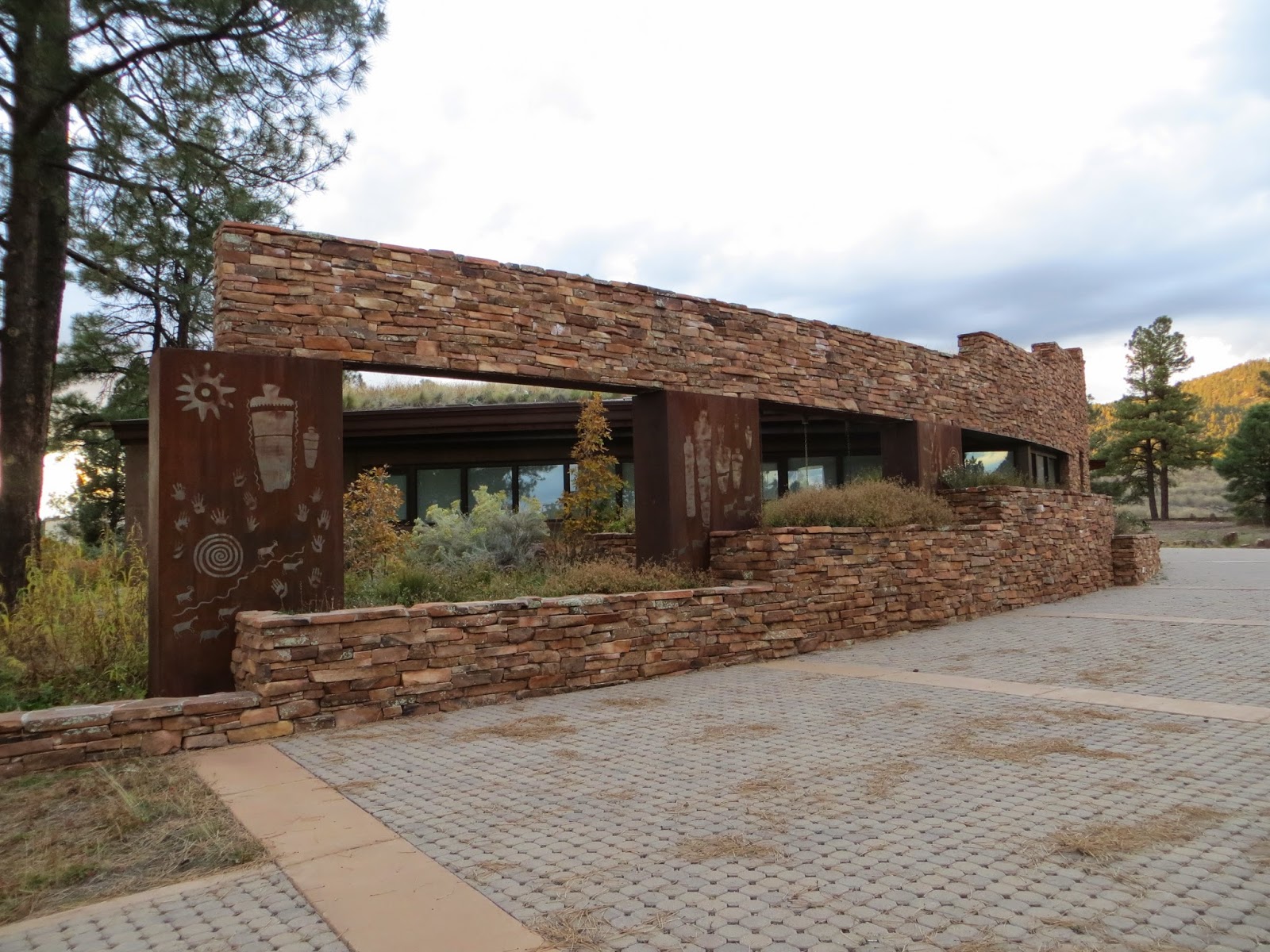

The Easton Collections Center

The building was designed with input from three perspectives. Because it is a collections storage facility, typical collections care issue were addressed, including the HVAC system, physical access and the storage concerns for a mixed collection. For example, the building is heated and cooled through pipes in floor, rather than blowing air, which keeps blowing dust to a minimum. 

The ECC at sunset
Another important issue was that of sustainability. Most of the materials are local, including wood from a railway trestle that lay submerged under the Great Salt Lake. The high salt content naturally treated the wood and it now repels insects. In addition, the grass on the roof acts as an insulator and helps keep energy usage down.

Finally, the museum drew heavily on the perspectives of the local American Indian communities. 

The center is meant to blend in with the landscape, and the façade is reminiscent of pueblos. Doors and windows face east, and from several spots in the building there are views of the San Francisco Peaks, which are sacred to local tribes. All funerary objects and human remains are housed in another building.

In the large foyer there is a tall, thin, rectangular window. Sunlight comes in through the window and shines on the wall. On the solstices, it shines directly on the center of the large steel doors that lead to the actual collections storage space and on the equinoxes it shines on the corners. On the solstices and equinoxes, the doors are opened and the band of light shines onto the collections so that the objects can know the time of year.

As I mentioned, most of my work will not be done in the fancy building I just described. One of the big projects I am working on is a major inventory. The room that I am inventorying has about 75 units, and each unit has six shelves. Each shelf typically contains about four to ten boxes. While some boxes only have one or two objects, the majority have ten to thirty, and some boxes have a couple hundred. It may sound strange for a box to have 200 hundred objects, but it makes a little more sense when you consider that these are archeological collections. So, we’re talking potsherds, ground stone and lithics – small fragments of pots, arrowheads, pestles, axe heads and (at least to my untrained eyes) rocks. In other words, this is a very large undertaking.


Because the collection has moved a lot, this inventory is incredibly important. It's also a good way to familiarize myself with the museum's database (ARGUS) and the collections and it's strange numbering system (most definitely not the typical three-part number).

I will work on a wide variety of projects while I am at the Museum of Northern Arizona, and hopefully I will share some of the more interesting things on here!  And I will most certainly enjoy this beautiful place, surrounded by forests and mountains.
The San Francisco Peaks

14 October 2014

My Mountain is Waiting

You're off to great places, 
Today is your day!
Your mountain is waiting, 
So...get on your way!
~ Dr. Suess

I am excited to share with everyone my next adventure. I will spend my next year in Flagstaff, Arizona as the Anthropology Collections Assistant at the Museum of Northern Arizona.

Flagstaff, Arizona
A few weeks ago I knew almost nothing about Flagstaff other than the fact that it is in Arizona. Everyone immediately thinks of the Arizona desert, the blistering heat and tall saguaro cactus. But Flagstaff is different. If in doubt, just take a look at these photos (which are not mine) from Flagstaff.


The highest temperature ever recorded in Flagstaff is 97, and it is apparently the only city Arizona that has never recorded a temperature of 100. With cool temperatures and a high elevation comes winter snow. In fact, Flagstaff averages 100 inches of snowfall a year, making it the fifth snowiest city (with a population of 50,000 or more) in the US. And yep, that's a ski lift right there. Just 7 miles outside of Flagstaff. Who knew?


Through my internet exploration I have discovered several random and interesting facts about Flagstaff:
  • Pluto was discovered at the Lowell Observatory in Flagstaff
  • Coconino County is the second largest county in the contiguous United States
  • Flagstaff's elevation is just under 7,000 feet. That's high up there, folks!
  • Flagstaff sits on the historic Route 66 (as does Yukon, OK, where I spent a lot of time this past summer)
  • While Flagstaff is not a huge city (just over 68,000 residents), Northern Arizona University adds an additional 25,000 people to the population
  • Because of its high altitude, olympic athletes like to train in Flagstaff
  • Flagstaff is just a 90 minute drive from the Grand Canyon

Yes, I'm Terrified
Is it fair to say that I'm a little terrified? You bet. I'm about to drive over 800 miles across a barren wasteland to live in a city I've never been to. Yep, terrified would be one word for it.

But I'm also excited. I'm excited about this new adventure, the work I will do and the things I will learn. Per the job announcement, I will work on a variety of collections projects at the museum. The Museum of Northern Arizona serves as a repository for some National Park Service collections, so I will be working with archaeological artifacts, including Coconino National Forest collections, Bureau of Indian Affairs collections and other NAGPRA projects. For those of you not up to date on the lingo, NAGPRA is the Native American Graves Protection and Repatriation Act. This federal law was enacted in 1990 and involves human remains, funerary objects and religious artifacts.

Museum of Northern Arizona and the Colorado Plateau
The Museum of Northern Arizona collects, studies, preserves and interprets the natural and cultural heritage of the Colorado Plateau. The Colorado Plateau is basically the four corners region of Arizona, Utah, Colorado and New Mexico. In this area are 10 national parks and 17 national monuments. In other words, the Colorado Plateau is filled with cultural, geological and paleontological treasures. MNA's ethnological collection includes significant Hopi and Navajo collections, Zuni and Apache objects, and smaller numbers of objects from a variety of Pueblo tribes.

The Colorado Plateau (In case you were wondering, I didn't take this picture either)
Later this week I will make the drive out to Flagstaff. I plan to update this blog on a more regular basis, but I will admit that I often don't post as often as I would like. I'm also more likely to post on
other platforms such as Facebook and Instagram, where posts require little more that the push of a button - so follow me there!

It's hard to leave Texas behind. It's hard to leave my friends and family behind. But my mountain is waiting, and it's time to get on my way!